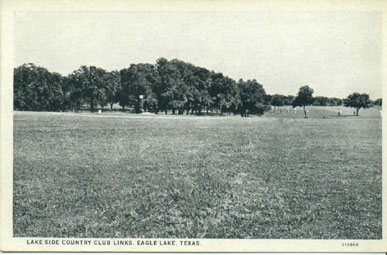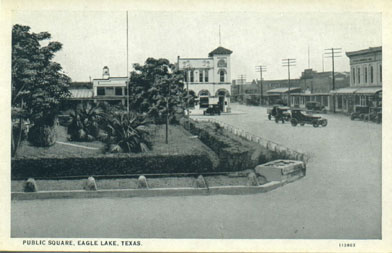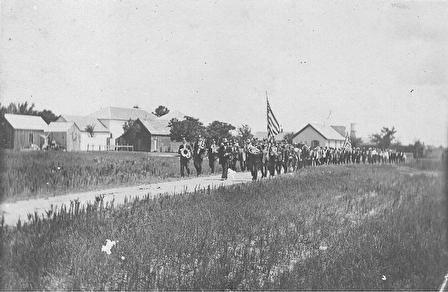
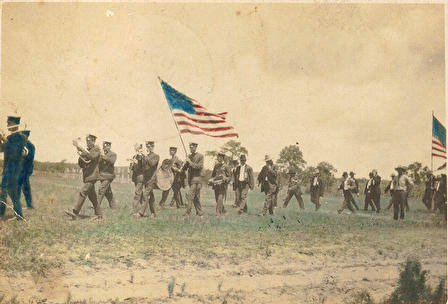
Eagle Lake Parade ca
1911
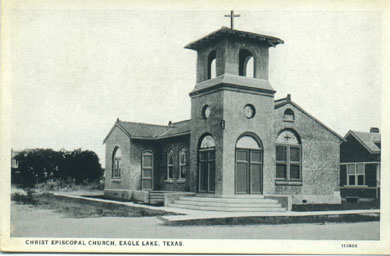
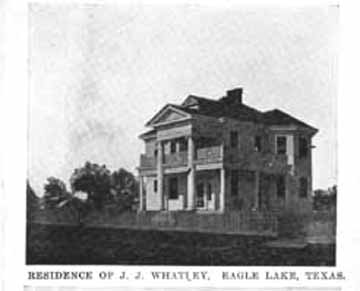
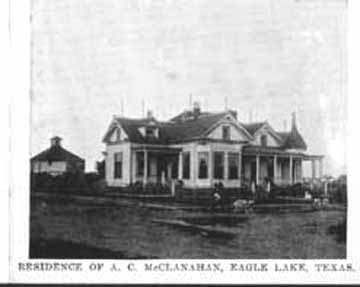
Above postcards from the collection of Laura Belle Shinn Drumm
contributed by Earnest Mae Seaholm
Letter from Eagle Lake.Editors of Citizen: . . . Please excuse me, Messrs. Editors, and let me speak a few moments of the rapid growth and flourishing condition of Eagle Lake City, situated in the lower portion of Colorado county, and at present the terminus of the B. B. B. & C. R. R. Whilst her people possess indomitable courage and industry, I know of no village that has made such rapid Trojan strides of improvement as Eagle Lake. Like magic she has sprang into existence, and is now rivaling the most populous and prospering village in the whole country. Six months ago, and not the slightest solitary sign marked the spot where she now stands amid her growing prosperity. Where once was heard the chime of frogs and the the thundering voice of the alligator, now many be heard the knocking of the industrious mechanic's hammer and chop-axe, and the general cling-clang of business and confusion. The great Iron Horse has at last made its appearance with a puff! puff!! puff!!! now and then having to stop and take on steam to make a genteel squeal on their arrival in town. |
Eagle Lake possesses some half-a-dozen houses, and near fifty inhabitants; a large ware and commission house by Mr. J. F. Jenkins, (Who, Mesers. Editors, is a man of business and accommodating qualities; all business entrusted to his care will receive the most prompt attention;) two dry goods stores—one by Henry Demoss, Esq., who keeps on hand an assortment of ready-made clothing, hats, caps, boots, shoes and baby dolls. Eagle Lake has also two bar rooms, a restaurant that cannot be surpassed by any in the State, and you know, Messrs. Editors, they are quite essentials to the growth and prosperity of every village. Any time, Mr. Editor, you wish a little fine Cognac, for the stomach's sake, or wish to smack your lips over the delicate and delicious green-head frog, the agile perch, and the athletic trout, o which the Lake so much abounds, when you are passing, just fall in, and you are sure to be accommodated. I know Messrs. Editors, you have already began to think that we are deficient in one thing needful to make a complete village, a newspaper. But hold! just wait for the wagon—this mammoth project and undertaking is on foot by some of our more energetic citizens, and ere long you may look for the "Eagle Lake News Revealer," to be placed upon your exchange table, bearing the most important and interesting news and thrilling events of the whole country. |
Schools and churches will be established soon, and a general improvement of the whole country and society is expected. I also understand that a Lyceum has been established, or will b soon, for the improvement and development of the mind, "teaching the young idea how to shoot," in which the most important and weighty considerations and questions of the day, pertaining to the general interest of the country and State, both political and religious, will be discussed and extensively debated upon. But excuse me, I have occupied your time and space too much already. More soon. LOGAN, Jr. Eagle Lake, December 1, 1859 Colorado Citizen, Thursday, December 8, 1859 |
Eagle Lake Parade ca 1911
Above postcards from the collection of Laura Belle Shinn Drumm
contributed by Earnest Mae Seaholm
Eagle Lake in the Colorado County Sesquicentennial Commemorative Book
Historical Marker for Town of Eagle Lake
Eagle Lake Chamber of Commerce
Eula & David Wintermann Library
Take a look at Eagle Lake, Texas at TexasEscapes.com
Eagle Lake as seen on Texas Trails
The Eagle Lake Headlight
Searchable images of The Eagle Lake Headlight from 1903 - 1996, as well as the November 13, 1895 issue of The Headlight, September 9, 1893 Eagle Lake Canoe, and April 30, 1904 Eagle Lake Advertiser are online at the Eula and David Wintermann Library web site [TEMPORARILY NOT WORKING]
|
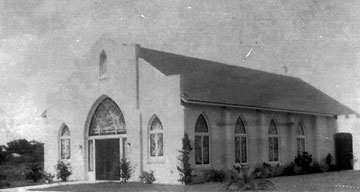
Colley Memorial Methodist Church
Courtesy of Helen Canaris Wilson |
It Was in the News
Miscellaneous items from area newspapers
Train Derailed Near Eagle Lake, TX - 1912
The Joseph Jefferson Mansfield Family at Nesbitt Memorial Library web site
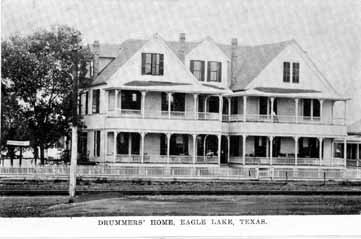
Drummer's Home - Eagle Lake, Texas - around 1910 |
|
|
|
|
|
First Home of Gail and Olaf Kolberg |
|
THE LEGEND OF EAGLE LAKEJoseph G. French. In the spring of 1823, while the Southern shores of our beautiful Lone Star State were decked in green, dotted here and yon with the fragrant blossoms of myriad wild fruits and flowering shrubs, the shores of lake and river banks and the rolling prairies were emerald beneath the azure of the sky; while birds of gay plumage and sweet voices sang amid this beauty and lazy bees droned around the flowers, the savage Caranchura Indians roamed unmolested amid these scenes of peace. Near the shores of a charming lake curled the blue smoke from the campfires of this nomadic tribe. From time unknown they had roamed at will through the forest, chased the deer over hill and dale, or fished in the crystal waters of the beautiful lake upon whose shores their camp fires now burned. The little Indian babes had been reared to manhood and maidenhood, had been taught the ways of their fathers and mothers, had loved and woed[sic] and won. Birth, love, marriage and death had followed each the other in natural order for successive generations with little change to vary the monotony of life. |
At this time there were many beautiful maidens among the tribe, whose dark hair and sparkling eyes won glances of admiration from many a broad-shouldered brave. Of all, the most admired was Prairie Flower, the lovely daughter of the tribe's chief. She was comely to look upon, just blooming into womanhood, her hair as dark as midnight and eyes that flashed and sparkled in star-like beauty. Many suitors had Prairie Flower, for the fame of her beauty had spread far and wide, and the braves of other tribes came for miles to pay court to this daughter of the Caranchua chief. Prairie Flower loved, not wisely, but too many, and of all the numbers who had sought her hand she could say whom she would choose; her choice lay, however, between two of the youths of her own tribe: Light Foot and Leap High. As she could not choose between them she decided to make a love test and calling her admirers to her side, as she stood upon the shore of the lake, she said, pointing to a tall cottonwood tree which grew upon the opposite shore, and which had for years unnumbered been the nesting place of an eagle: "The tree is high; the wee ones cry for food; the bird of the broad and sweeping wing will go hunting for her small ones. To him who climbs the tree and first brings to me one young eaglet ever will I be true my love shall ever be his.” |
Each anxious to outdo the other, Leap High and Light Foot at once set out to cross the Lake. Telling her brother of her test, she asked him to paddle her across to the opposite shore. When they arrived they found fifty canoes and the lusty red men cheering for their favorites. The tree was very hard to climb and they had only their scalping knives to aid them in the ascent. After much effort Leap High reached a limb; the climb bad been too great a test for his strength and he stopped to rest. Light Foot continued, reached the nest at the top of the tree, secured one of the young eagles and putting it in his deer skin hunting pouch descended. Leap High, crestfallen, sulked in the woods near the shore of the lake. Thus was the name of Eagle Lake bestowed upon this beautiful expense of water by the cruel Caranchua Indians in 1823. In 1855 the present city of Eagle Lake was founded on the adjacent prairie was named after the lake, Eagle Lake. This city is in Colorado county and has at present two thousand inhabitants, two four-story rice mills, ice factory, electric lights, and one of the largest sugar mills and refineries, not only in Texas, but in the United States. This is 100 miles from Galveston and 141 miles to San Antonio. Weimar Mercury, June 10, 1905, page 6 |